




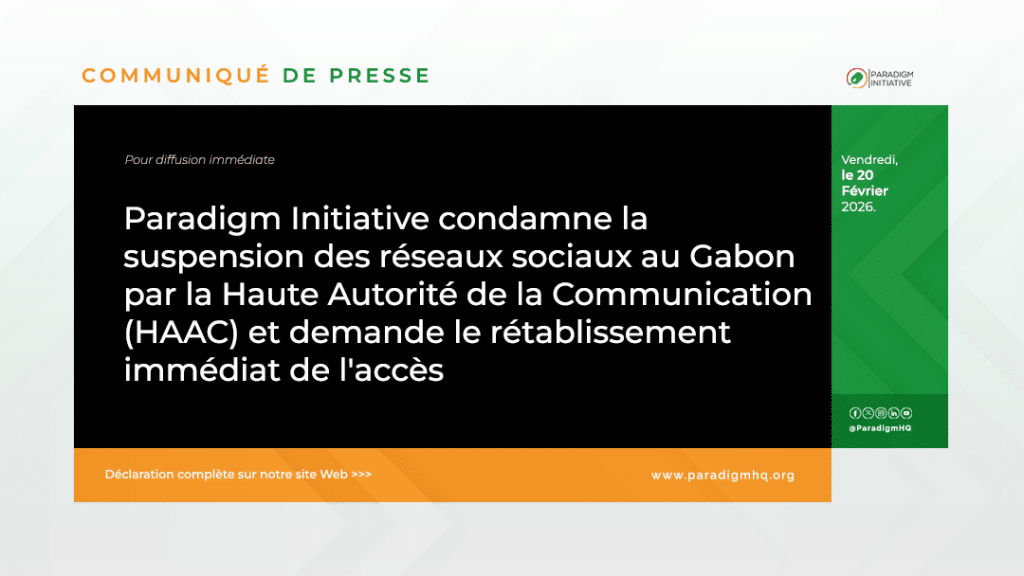
Paradigm Initiative (PIN) strongly condemns the suspension of major social media platforms in Gabon by the Haute Autorité de la Communication (HAAC), announced on February 17, 2026, and still ongoing as of February 20th, 2026. The directive reportedly restricts access to platforms including Meta services (Facebook, WhatsApp, Instagram), TikTok, and YouTube, purportedly to curb “hateful, defamatory, or injurious” content deemed threatening to national stability. However, the HAAC has failed to provide specific evidence of violations, clarity on the legal basis for the measure, or a timeline for restoring access.
Technical monitoring by NetBlocks and independent observers confirms that the disruptions are affecting Meta platforms, YouTube, and TikTok across Gabon. Reports indicate that users have resorted to virtual private networks (VPNs) to circumvent restrictions, while connectivity remains unstable nationwide.Blanket platform suspensions constitute a grave violation of digital rights, including freedom of expression and access to information. They disproportionately silence public discourse amidst ongoing anti-government protests and a labour strike in Gabon.
Beyond civic space implications, the suspension carries severe economic consequences estimated at $2,960,568 Total Cost Impact (FCFA 1,781,414,598 CFA Franc BEAC) for two-day shutdown of WhatsApp, Facebook, Twitter, and YouTube, based on the Netblocks loss per day calculation tool. Social media platforms serve as critical tools for entrepreneurs, small businesses, freelancers, journalists, and civil society actors. Restricting access disrupts commerce, digital payments coordination, customer engagement, and livelihoods, particularly for young people and informal sector actors who rely heavily on these platforms. Gabon has previously experienced digital disruptions during periods of political unrest. The recurrence of such measures signals a troubling pattern that undermines transparency, civic participation, and democratic governance.
Article 9 of Gabon’s Constitution guarantees freedom of expression and information. As a State Party to the International Covenant on Civil and Political Rights (Article 19) and the African Charter on Human and Peoples’ Rights (Article 9), Gabon is obligated to ensure that any restriction on expression meets the three-part test of legality, necessity, and proportionality. Indiscriminate platform suspensions fail this test. The United Nations Special Rapporteur on Freedom of Opinion and Expression has consistently affirmed that internet shutdowns are inherently disproportionate under international human rights law. Similarly, the African Commission on Human and Peoples’ Rights Principle 38(2) of the Declaration of Principles on Freedom of Expression and Access to Information in Africa, clearly guides that States shall not engage in or condone any disruption of access to the internet and other digital technologies for segments of the public or an entire population. As such, Gabon’s actions violate fundamental rights and freedoms as obligations under these instruments require the government to protect, not curtail, digital civic space.
Internet Service Providers (ISPs) and technology companies operating in Gabon also have responsibilities under the United Nations Guiding Principles on Business and Human Rights. They must ensure transparency regarding government orders affecting connectivity and avoid complicity in human rights violations, accounting to their users. Any failure in this regard impedes the proper exercise of contractual obligations and human rights responsibilities.
To urgently address human rights concerns, Paradigm Initiative calls for the following:
- Immediate restoration of full and unrestricted access to all affected social media platforms
- Transparency from the Haute Autorité de la Communication (HAAC), including publication of the legal basis and any relevant information on the envisaged order that affected internet access.
- Transparency notices from internet service providers (ISPs) detailing the government directives affecting internet access.
//ENDS//