




Finding familiar waters
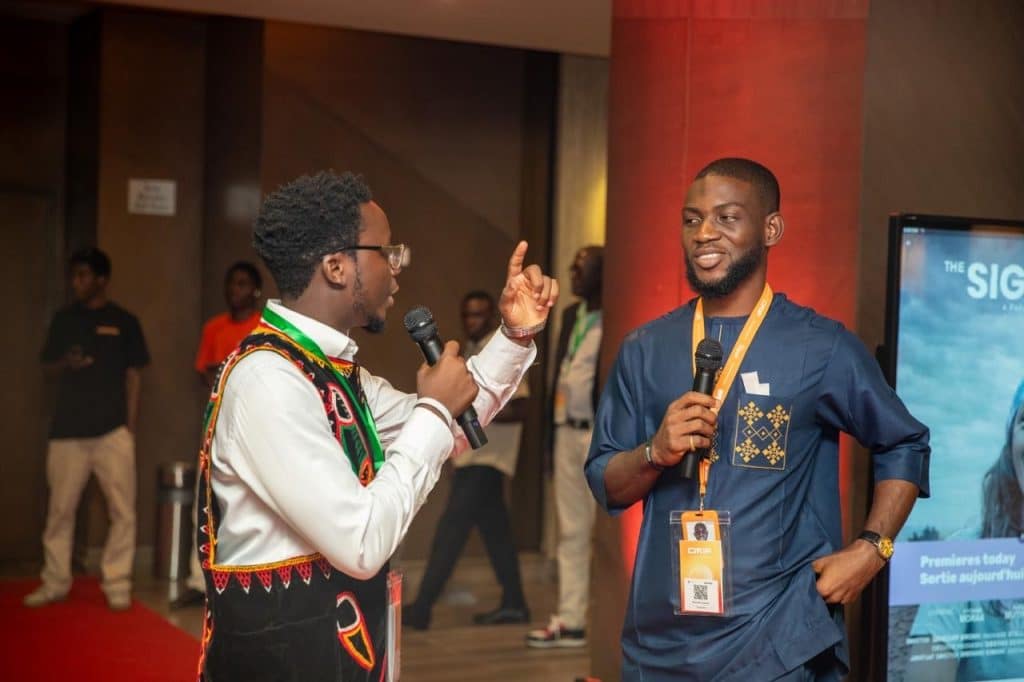
I hosted the short film premiere and launch of the Londa report at the 2026 Digital Rights and Inclusion Forum (DRIF26) in Abidjan, Côte d’Ivoire. While planning backstage with my fellow cohost, Jedidja Gnali, she paused for a moment and said something along the lines of “they were right, you have done this before.”
“Countless times,” was my response.
My first steps into MCing date back to university. As a journalism student and campus radio host, I would also take on side gigs, moderating weddings, graduation ceremonies, and youth events for extra change. Somewhere between chasing vox pops, editing audio at odd hours, and surviving student life in Buea, I discovered that I genuinely enjoyed wielding the microphone.

For some years, I had somewhat folded up that suit and tucked it away. But journalism, the very profession that introduced me to public speaking, never really left. If anything, it anchored itself deeper into my professional seabed. So, finding myself, years later, floating in advocacy waters was a familiar feeling. Journalism and advocacy, after all, are cousins. Both are built on the idea of inspiring change.
That is perhaps why my work with Paradigm Initiative (PIN) feels deeply personal. It is rooted firmly in my training and service as a reporter in one of Sub-Saharan Africa’s most complex sociopolitical countries – Cameroon. Our bilingual status and other fallouts of our postcolonial history continue to set us apart as a unique triangle on the African continent. In our purely natural quest for association, we have found more than a friend in Côte d’Ivoire. Considering each other as in-laws, Côte d’Ivoire and Cameroon share a rather romantic diplomatic relationship. So when Abidjan was announced on that stage in Lusaka as the next host city for DRIF26, my joy hit differently. I was glad to be visiting la belle famille once again.
Immediately, my imagination ran wild. I pictured hundreds of participants flooding large conference hallways like we saw at the Mulungushi International Conference Centre in Zambia at DRIF26. I imagined intense panel conversations spilling into coffee breaks, random networking moments and all the fun stuff that comes with DRIF. I especially dreamed about the podcast room, which is gradually becoming another DRIF-induced space where ‘strangers’ rally over the mic for a common cause – digital rights and inclusion.
And somehow, the universe exceeded every single expectation. But looking back now, I realise the road to DRIF26 became just as fulfilling as the Forum itself. Every team meeting brought new perspectives. Every planning session uncovered new challenges too, and trust me, there were plenty of those. Some were logistical, some were technical and at one point, I became convinced that communications work is simply the art of professionally solving problems nobody warned you about. Still, there was beauty in it. There always is.
Once the digital spells were cast, it was time to manifest our presence and hit the ground running in Abidjan. One of my personal highlights came even before the official opening.
Meeting local reporters during a media training session on the eve of the Forum was unexpectedly moving. Many of them admitted they had never really heard conversations framed around digital rights before. Watching their faces as my colleague Joshua broke down concepts like digital security was genuinely satisfying.
Questions kept flying across the room. Some were about digital inclusion in daily reporting, others wanted to understand digital surveillance and how it affects their work. Some were keen on how to keep their gadgets safe, and perhaps my favourite part was the repeated requests to access the Londa25 report once it officially launched.
For a continent often described through the lens of digital gaps, misinformation, and technological dependency, there is something deeply hopeful about seeing journalists eager to understand and own conversations around digital rights themselves. Their attentiveness was even more remarkable considering there were two or three other major international events happening simultaneously in Abidjan that week. Yet there they were, engaged, curious, asking questions and taking notes. And all this came to life fully when they started to file in their reports.
For any digital rights advocate, that kind of interest is enough motivation to keep going. By then, all the pieces seemed aligned. The momentum for DRIF26 proper was building and just when I was already preparing mentally to add DRIF26 to my personal Mount Rushmore of unforgettable digital rights convenings, the first serious on-ground challenge reared its head.
Giyo Ndzi is Communications Officer at Paradigm Initiative. This piece is part of his personal reflections and experiences from the 2026 Digital Rights and Inclusion Forum (DRIF26) in Abidjan.