




Global conversations about artificial intelligence (AI) are accelerating, while there is slow progress in Africa on developments of national AI strategies. International summits are positioning the technology as the next engine of economic growth. Against this backdrop, companies are racing to release new systems offering deals for uptake of AI. At first glance, the mood is confident and forward-looking.
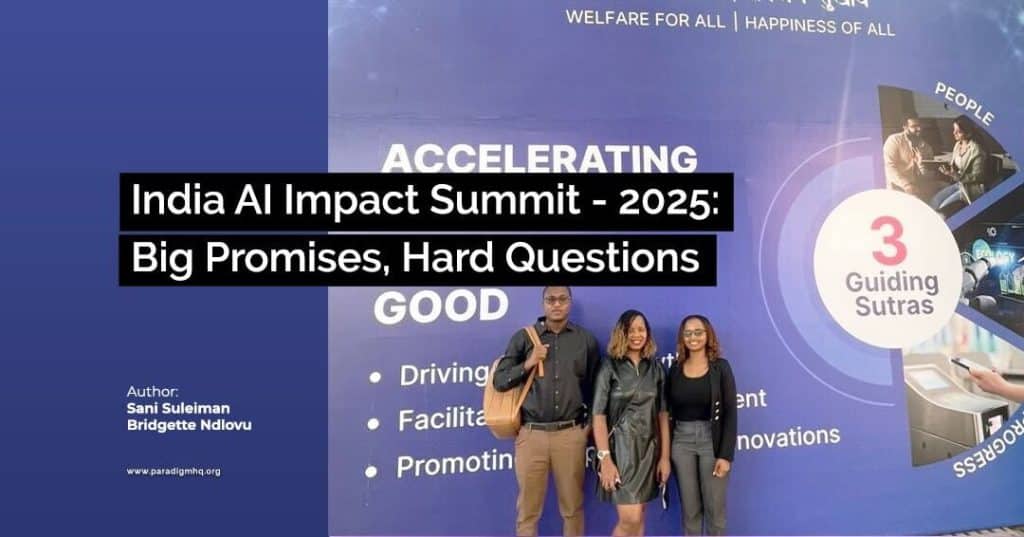
The development-based optimism was on full display at the AI Impact Summit in India, held in Delhi between 16 to 21 of February, where political leaders, technology executives, and investors gathered to discuss how artificial intelligence could reshape the global economy. Paradigm Initiative sent a 3 person delegation to the summit. The message from the main stage was clear. AI is no longer experimental. It is becoming a central force in industry, governance and everyday life.
Yet the summit also revealed a quieter tension devoid of human rights as a priority. While the event was framed as a conversation about impact, much of the discussion focused on investment, market expansion and geopolitical positioning. The harder questions about inequality, governance and long-term risks received far less attention. The salient soft approach to human rights gave a trade-off with terms like safety and responsibility being the overacrching terms that steered conversations. This gap matters because the global starting point for AI adoption is far from equal.
A glimpse of the Global AI Divide
Recent international assessments of AI readiness show a stark divide between advanced economies and much of the Global South. Wealthier countries score far higher across measures of digital infrastructure, human capital, innovation capacity and regulatory frameworks. Emerging markets and low-income countries trail significantly behind.
These differences are not minor technical details. They shape which countries can realistically build and govern AI systems and which will depend on technologies developed elsewhere.
Digital infrastructure is the first obstacle. Connectivity has expanded rapidly in many regions, but affordability remains a major barrier. In parts of Sub-Saharan Africa, mobile data can consume a large share of average income. Even where network coverage exists, millions of people remain offline because regular internet use is simply too expensive.
Infrastructure gaps go beyond connectivity. Reliable electricity remains inconsistent in many areas, including schools expected to adopt digital learning tools. When basic systems such as power and internet access are still uneven, deploying advanced AI solutions becomes difficult to sustain at scale.
In the age of AI, data extractivism surfaces as a major concern as big tech companies harvest large datasets, often from public web content, user interactions and especially from communities in the Global South, to train AI models and generate economic value with little consent, compensation or local benefit.
Human capital presents another challenge. Artificial intelligence relies on skilled engineers, researchers and data specialists. Yet many countries face deep shortages in technical education. Across several African countries, only a small share of young people possess basic computer skills. Science, Engineering, Technology and Mathematics (STEM) graduation rates remain low and the current pace of training would take decades to produce the workforce needed for large-scale AI development.
Gender disparities make the situation more complex. Women remain significantly underrepresented in engineering and technology fields in many regions. That imbalance limits both the size and diversity of the talent pool and shapes who participates in designing the technologies that will influence society.
Innovation capacity is another dividing line. Countries that invest heavily in research and development tend to produce their own technologies and companies. Many lower-income economies do not yet have that ecosystem. Limited financing for startups, smaller research budgets, and weaker links between universities and industry mean that local innovation struggles to scale.
The result is a familiar pattern in technology development. Instead of building solutions tailored to local needs, many countries end up importing tools developed in the Global North. That dependency makes it harder to shape how AI is designed, deployed and governed.
The governance challenge
Governance itself is still catching up almost everywhere. Many governments are only beginning to develop national AI strategies or ethical guidelines. Clear rules on transparency, accountability, and data protection remain incomplete across large parts of the world.
These structural gaps formed an important but largely unspoken backdrop to the AI Impact Summit.
From a geopolitical perspective, the event highlighted India’s growing ambition to position itself as a global AI hub. The country secured several commitments related to investment, research partnerships and workforce development. Many speakers described India as an ideal location for AI expansion because of its large population of engineers, its established technology sector, and its rapidly growing digital economy.
For India, this attention represents a significant opportunity. New investments could support technology hubs, training programs and high-value jobs. The country has already built strong capabilities in software development and digital services and AI offers a chance to expand that influence. For other countries in the Global South, with limited skills and resources, the AI divide remains.
At the same time, the enthusiasm surrounding AI development raises practical questions about the nature of the work being created. Much of the global AI industry relies on large networks of data workers who label images, review content and train algorithms. These tasks are essential but often poorly paid and rarely discussed in public conversations about innovation.
As AI investment expands, the quality of these jobs will matter as much as their quantity. Fair wages, stable working conditions, and long-term career opportunities will determine whether the industry strengthens local economies or simply outsources invisible digital labor.
Multistakeholder participation in Global AI governance
Another noticeable feature of the summit was an uneven participation landscape with civil society organisations (CSOs) and human rights advocates with limited visibility on the main stage. CSOs were at the India AI impact and found greater relevance in the networking as well as side events that aligned with the focus of the Summit, presenting greater opportunities for meaningful partricipation. Many of the discussions about risks took place in smaller side sessions rather than in the headline panels.In those sessions, researchers and advocates raised concerns that rarely surfaced in the official programme. Participants discussed the potential use of AI in military systems, including autonomous drones capable of selecting targets with minimal human oversight. Others focused on the rapid spread of deepfake technology and the risks it poses to elections and public trust.
There were also calls for stronger transparency requirements for AI developers, better protections for personal data, and greater participation from countries in the Global South in shaping global standards.Researchers, policymakers and technologists have been raising these issues for years, ephasising the need for humnan rights to become a key feature in AI impaxct Summits as these are lived impacts that come alongside the benefits of AI. By the time the summit concluded, the official message remained overwhelmingly positive. Governments emphasised job creation and economic growth. Technology companies highlighted responsible innovation and ethical commitments. New partnerships were announced and the momentum around AI development continued to build. Artificial intelligence has real potential to improve healthcare systems, accelerate scientific research and make public services more efficient.
But optimism works best when it is matched with realism.
Thinking of the future
The global race to develop AI is not taking place on equal ground. Large parts of the world still face deep infrastructure gaps, shortages of technical talent, and limited capacity to shape the rules governing new technologies. Without addressing these structural realities, the benefits of AI will likely remain concentrated in the countries that already have the strongest foundations.
Events like the AI Impact Summit show how quickly the conversation about AIis moving. They also reveal how much work remains to ensure that this technological transformation is inclusive rather than exclusive. As the Swiss government, which will host the Swiss AI Summit in 2027 plans the summit, we call for meaningful participation by diverse stakeholders and for a democratic summit anchored in human rights, consistent with the multistakeholder principles outlined in the Sao Paulo Guidelines for multistakeholder consensus-building and decision-making . In the future, we hope the summit will not only promote innovation and industrialisation but also enhance human rights standards in the design, development, and deployment of AI worldwide.
Authors: Sani Suleiman, and Bridgette Ndlovu