





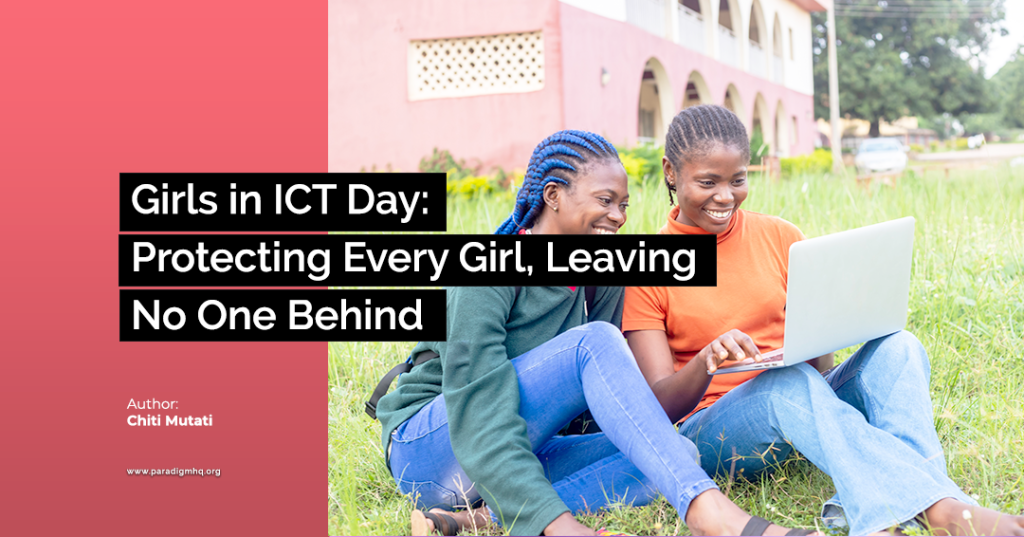
Paradigm Initiative (PIN) celebrates International Girls in ICT Day 2026 under the theme “AI for Development: Girls Shaping the Digital Future”. This is pertinent for Africa, as the fastest-growing continent is expected to host over 830 million youths by 2050. The region’s adolescent girls will also represent one-third of the world’s adolescent girls by 2050.
As more countries pursue their digital transformation ambitions, the technology sector increasingly offers a path forward for economic development; technologies such as AI, cloud computing, and software development are projected to contribute USD1.5 trillion to the continent’s GDP by 2030. However, the digital divide continues to threaten women and girls’ ability to participate equitably in an increasingly technology-driven world. This heightens the need to ensure opportunities for young women’s economic empowerment in a region already burdened by a youth unemployment crisis.
The article below leans on PIN’s digital skills training work across the region, findings from our latest report on digital rights and inclusion across 29 African countries, Londa, as well as our survivor-led study on technology-facilitated gender-based violence (TFGBV), ‘Clicks That Hurt’, to explore the the region’s progress in empowering and protecting girls in ICT, measured against key World Summit on the Information Society (WSIS) action lines.
Education, training and opportunities for women and girls
According to UNESCO, the average for women graduates in Science, Technology, Engineering and Mathematics (STEM) subjects is only 35%, with them making up only 26% of the Data and Artificial intelligence workforce. Thus, girls and women face being left out of high-value digital spaces, as lower representation in education and then employment compounds inequalities.
This concern is also echoed by the United Nations General Assembly (UNGA) in the WSIS +20 review outcome document. Notably, it concedes that for many children and young people, the benefits of digitalisation have not materialised, due to inequalities in connectivity, digital literacy, equipment, skills and educational facilities.
Recognising the importance of strategic investment in crucial digital skills for the continent’s youth and particularly young girls, PIN is focused on targeted education, training, and opportunities for young people in STEM fields. Through this, the region can address the existing digital skills gap, foster innovation, and become more competitive in the global technology landscape.
To that end, since 2007, PIN has pursued a digital skills and literacy project called LIFE Legacy. The gender-responsive programme focuses on Life Skills, ICT Skills, Financial Literacy, and Entrepreneurship to enhance the livelihoods of underserved African youth. It is a training programme in essential skills, supporting participants to secure internships, freelance work, entrepreneurship, and/or other forms of post-training engagement. It is currently active in Cameroon, the Democratic Republic of the Congo, Ghana, Kenya, Liberia, Malawi, Nigeria, Senegal, South Sudan, Tanzania, Uganda, Zambia, and Zimbabwe. Thus far, over 150,000 youth have benefited, with numerous success stories from young women across the continent.
The spread of digital connectivity across Africa has created new frontiers for expression, entrepreneurship, and civic participation. However, these opportunities risk being tempered by the advent of digital spaces emerging as spaces for gendered digital exclusion, discrimination, and even violence.
Promoting the protection of girl children online
In the WSIS+20 review outcome document, the UNGA also recognises an urgent need to address online violence against children, recognising them as some of the most active users of the Internet and online services. It affirms a commitment to strengthening legal and policy frameworks to protect children’s rights of the child in the digital space, aligning these with international human rights laws and principles.
However, our Londa report for 2025 notes that African countries still lag significantly behind in implementing digital safety guardrails as more young people work and play online. Many have yet to amend their Children’s Acts, and Cyber Acts have yet to include digital safety with a focus on online child safety. For example, in 2025, countries like Benin, Sierra Leone, the Democratic Republic of Congo (DRC), and Ethiopia lacked such laws or policies.
In a positive development, in 2025, some countries adopted child online safety policies and strategies. In Kenya, the government issued the Child Online Protection and Safety industry guidelines, Lesotho launched its Child Online Guidelines, Tunisia adopted the National Charter for the Protection of Children Online, and in Zambia, the government focused on enhancing online safety for children through the National Child Online Protection Strategy.
In conflict-stricken countries such as the Central African Republic, the protection of children online is conducted within a broader child protection framework led by United Nations agencies (such as UNICEF and the ITU) and the government. Increasingly, they are focused on promoting digital access for young girls and on applying ITU global guidelines to create a safe online environment for children.
In an increasingly unsafe online environment, gendered disinformation is also emerging as one of the largest barriers keeping women and girls out of the digital space, preventing their empowerment and benefiting from the region’s digital transformation. For example, for 2025, our Londa report on Ethiopia finds that women and girls face more hate speech, including gendered stereotypes and mockery, than men and boys, with an escalation of gendered attacks during the year.
Notably, human rights activist Yordanos “Jordin” Bezabih faced repeated attacks, including the hacking of her private accounts and the leaking of intimate photos, videos, and voice recordings online. Further showing the onset of emerging technologies such as AI being used against women, the material was then used to create deepfake content accompanied by coordinated calls for violence against her.
In Botswana, meanwhile, a significant development took place with the government finalising drafting instructions for a Gender Based Violence Bill, which recognises that technology-facilitated gender-based violence (TFGBV) must be addressed, within new frameworks, as opposed to solely addressing physical violence.
TFGBV: from abstraction to accountability
It is against the backdrop of the scourge of attacks on women and girls that Paradigm Initiative set out to conduct a survivor-led study on Technology-Facilitated Gender-Based Violence across six focus countries: Cameroon, Kenya, Nigeria, Senegal, Zambia and Zimbabwe between March and October 2025. The findings reveal that young people (aged 18-34) make up the majority of survivors of TFGBV, with more women (182) reporting abuse compared to men (92). 67% of respondents reported direct victimisation online, recording experiences such as sexual harassment, threats, stalking, non-consensual image sharing and more. Concerningly, the majority of respondents were unaware of mechanisms for redress through the platforms themselves, formal systems, or national legal routes. The result was that many survivors retreated from online life altogether.
Conclusion
As we commemorate Girls in ICT Day 2026, Paradigm Initiative commends the strides made by women and girls in actively engaging with digital technologies and in building an equitable future for themselves. We also call on national governments, civil society and technology companies to strengthen protections for girls online as we build a human-centred, safe and digital Africa.
In particular, we encourage governments’ implementation of action lines towards the achievement of the WSIS+20 commitments, particularly those around the Review or adopt various laws focused on children and gender-based violence, to ensure they address TFGBV, combating all forms of digital violence.
We also encourage technology companies to engage with civil society and communities for partnerships focused on gender-responsive digital skills training programmes, and the provision of affordable internet access and low-cost devices, through schools and communities, to enable more women and girls to access digital skills.
It is also integral for online platforms to establish more robust, inclusive reporting systems to process high-risk TFGBV cases, such as threats, sexualized abuse, and image-based violence, which happen against young girls on their platforms.